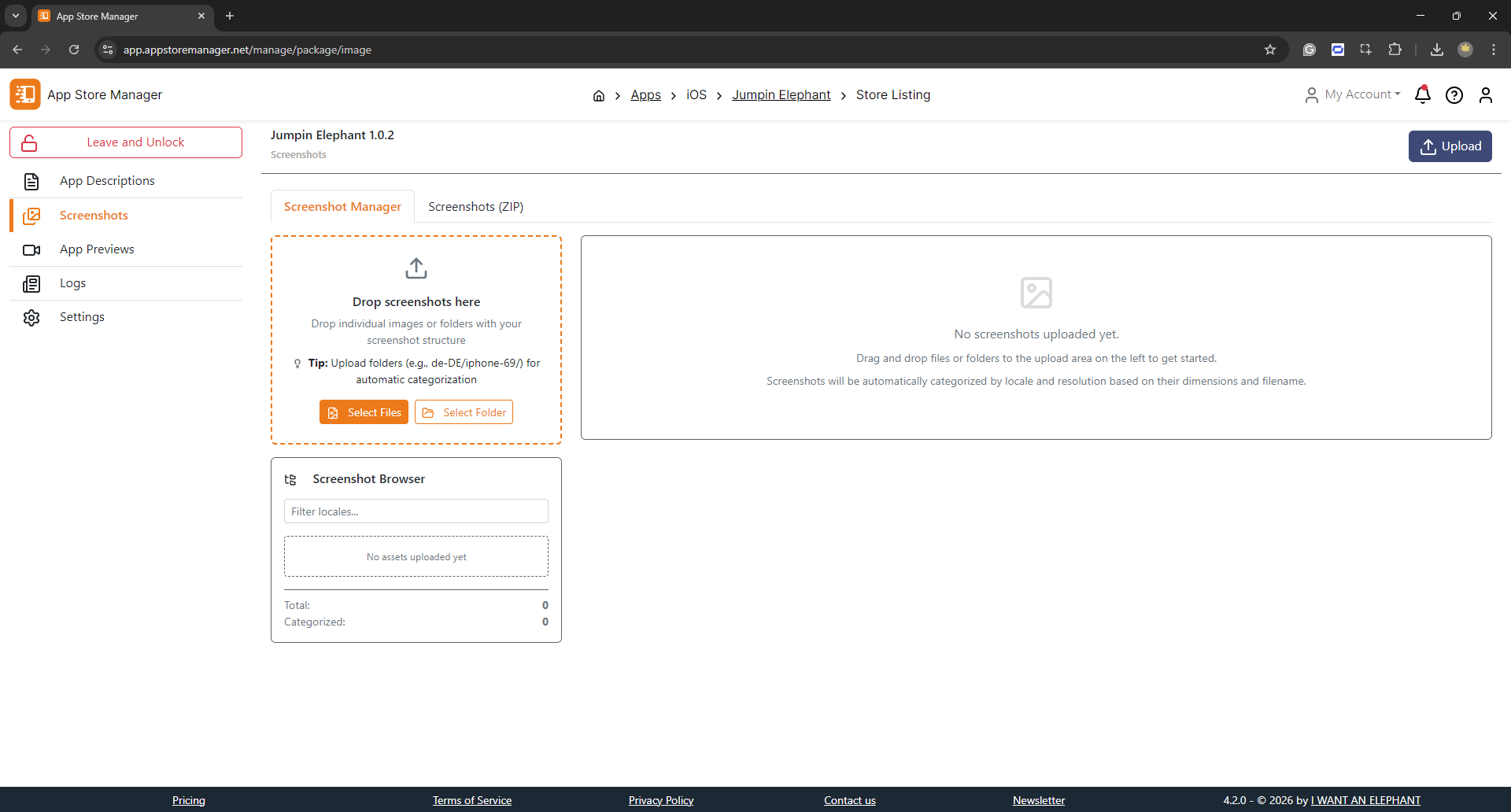
Screenshot and asset upload
Use App Store Manager to upload and transfer screenshots, icons, and feature graphics to App Store Connect (Standard & CPP) and Google Play Console — across all your supported languages and device sizes.

1. Before you start
Assets are stored for 180 days on Basic and Premium plans before automatic deletion. This does not affect your live store listings. Uploads can take up to 1 hour to complete (full upload with all resolutions and all languages).
Required permissions
Before you can transfer assets, make sure the following API access is in place.
Google Play Console — your API user needs these three permissions:
View app information
Edit and delete draft apps
Manage store presence
App Store Connect — a valid API key must be configured in your App Store Manager account settings.
2. Upload methods
There are three ways to provide your assets. The Screenshot Manager (drag & drop) is recommended for most users. ZIP upload and Google Drive provisioning are better suited for automated or bulk workflows.
Screenshot Manager
Day-to-day management, real-time control
Yes
Screenshots
Not available
Direct ZIP upload
Automated bulk processing
No
Screenshots
Screenshots, Icons, Feature Graphics
Google Drive
Sharing or storing archives externally
No
Screenshots
Screenshots, Icons, Feature Graphics
3. Screenshot Manager (drag & drop)
The Screenshot Manager gives you real-time control over your assets and is the only method powered by the Smart Recognition Engine.
This Drag & Drop option is currently available only in App Store Connect. Google Play will follow in Spring 2026.

What you can do:
Drag in single files, multiple files, or entire folder structures
Reorder screenshots by dragging within a slot
Manually assign any unrecognized files that land in "Uncategorized"
Replace individual positions — uploading to Position 4 only affects that slot; all others stay as-is

A "Remove all first" toggle is currently in development. For now, replacement is position-based only.
How the Smart Recognition Engine works
When you drop files, the engine runs three checks in order:
Step 1 — Language detection
The engine first tries to identify the locale from your folder structure, then falls back to the filename if no match is found.
Folder path scan (primary): Every folder segment in the path is checked left to right. The first segment that matches a known locale code or alias is used.
Filename fallback: If no folder matches, the filename is split at -, _, or spaces and checked against the same alias list.

The following aliases are recognized:
ar-SA
arabic, ar, ar-sa, ara, عربي, saudi
ca
catalan, català, catalonia
cs
czech, cz, cesky, čeština, czechia
da
danish, dk, dansk, denmark
de-DE
german, deutsch, de, de-de, deu, ger
el
greek, gr, ελληνικά, greece
en-AU
en-au, australian, australia
en-CA
en-ca, canadian-english
en-GB
en-gb, british, uk, england, united-kingdom
en-US
english, en, en-us, eng, us, american
es-ES
spanish, español, espanol, es, es-es, spa, castilian
es-MX
es-mx, mexican, mexico
fi
finnish, suomi, finland
fr-CA
fr-ca, quebec, canadian-french
fr-FR
french, français, francais, fr, fr-fr, fra
he
hebrew, il, עברית, israel
hi
hindi, हिन्दी, india
hr
croatian, hrvatski, croatia
hu
hungarian, magyar, hungary
id
indonesian, bahasa, indonesia
it
italian, italiano, ita
ja
japanese, jp, jpn, nihongo
ko
korean, kr, kor, hangul
ms
malay, my, melayu, malaysia
nl-NL
dutch, nl, nl-nl, nederlands, holland, netherlands
no
norwegian, nb, norsk, norway
pl
polish, polski, poland
pt-BR
portuguese, português, pt, pt-br, brazilian, brazil
pt-PT
pt-pt, portugal
ro
romanian, română, romania
ru
russian, rus, русский
sk
slovak, slovenčina, slovakia
sv
swedish, se, svenska, sweden
th
thai, ไทย, thailand
tr
turkish, türkçe, turkey
uk
ukrainian, ua, українська, ukraine
vi
vietnamese, vn, tiếng việt, vietnam
zh-Hans
chinese, zh-hans, zh-cn, simplified, mandarin, chinese-simplified
zh-Hant
zh-hant, zh-tw, traditional, chinese-traditional, taiwan
Step 2 — Slot order
The display position is read from numbers in the filename:
Numbers between underscores —
en-US_3_1290x2796.pngis placed in Slot 3Direct numeric names —
1.pngthrough10.pngare placed in the corresponding slot

Step 3 — Resolution detection
The target device is identified exclusively by the actual pixel dimensions of the image file. Folder names like "iPhone 15" are ignored. See Technical specifications below for the full list of supported dimensions.

4. Direct ZIP upload
Use this method for automated bulk processing. Files must be placed in the correct folders within the archive — the Smart Recognition Engine is not used here.
You must use the official templates. The folder hierarchy must be maintained exactly or the upload will fail.
Download the template for your platform before preparing your archive:
Download iOS Template | Download Android Template
File naming and minimums:
iOS
1.png – 10.png
3
Android
1.png – 8.png
2

5. Google Drive provisioning
This is an alternative to uploading a ZIP directly — useful if you want to store your asset archive externally or share it with a team member.
Upload the ZIP to Google Drive.
Set the sharing permission to Viewer.
Paste the share link into the App Assets field in App Store Manager.

6. Technical specifications
The system matches image files to their target device based on exact pixel dimensions. The values below are the only ones recognized — no rounding or approximation is applied.
iOS — App Store Connect
iPhone 6.9"
1320 × 2868
2868 × 1320
iPhone 6.7"
1290 × 2796
2796 × 1290
iPhone 6.5"
1242 × 2688
2688 × 1242
iPhone 5.5"
1242 × 2208
2208 × 1242
iPad Pro 13"
2064 × 2752
2752 × 2064
iPad Pro 12.9"
2048 × 2732
2732 × 2048
Android — Google Play Console
Phone / Tablet
Min 320px, max 3840px — 9:16 portrait or 16:9 landscape
App Icon
512 × 512 px, 32-bit PNG
Feature Graphic
1024 × 500 px, JPG or 24-bit PNG
Last updated